From Visual Synthesis to Interactive Worlds:
Toward Production-Ready 3D Asset Generation

Production-Ready 3D Survey
Jiafeng Wu1,2*†, Zhuofan Lou1,3*†, Jian Liu1‡, Dazhao Du1, Chunchao Guo4, Song Guo1✉
1 The Hong Kong University of Science and Technology  ·  2 Huazhong University of Science and Technology
3 Sichuan University  ·  4 Tencent
* Equal contribution Work done during internship at HKUST Project lead Corresponding
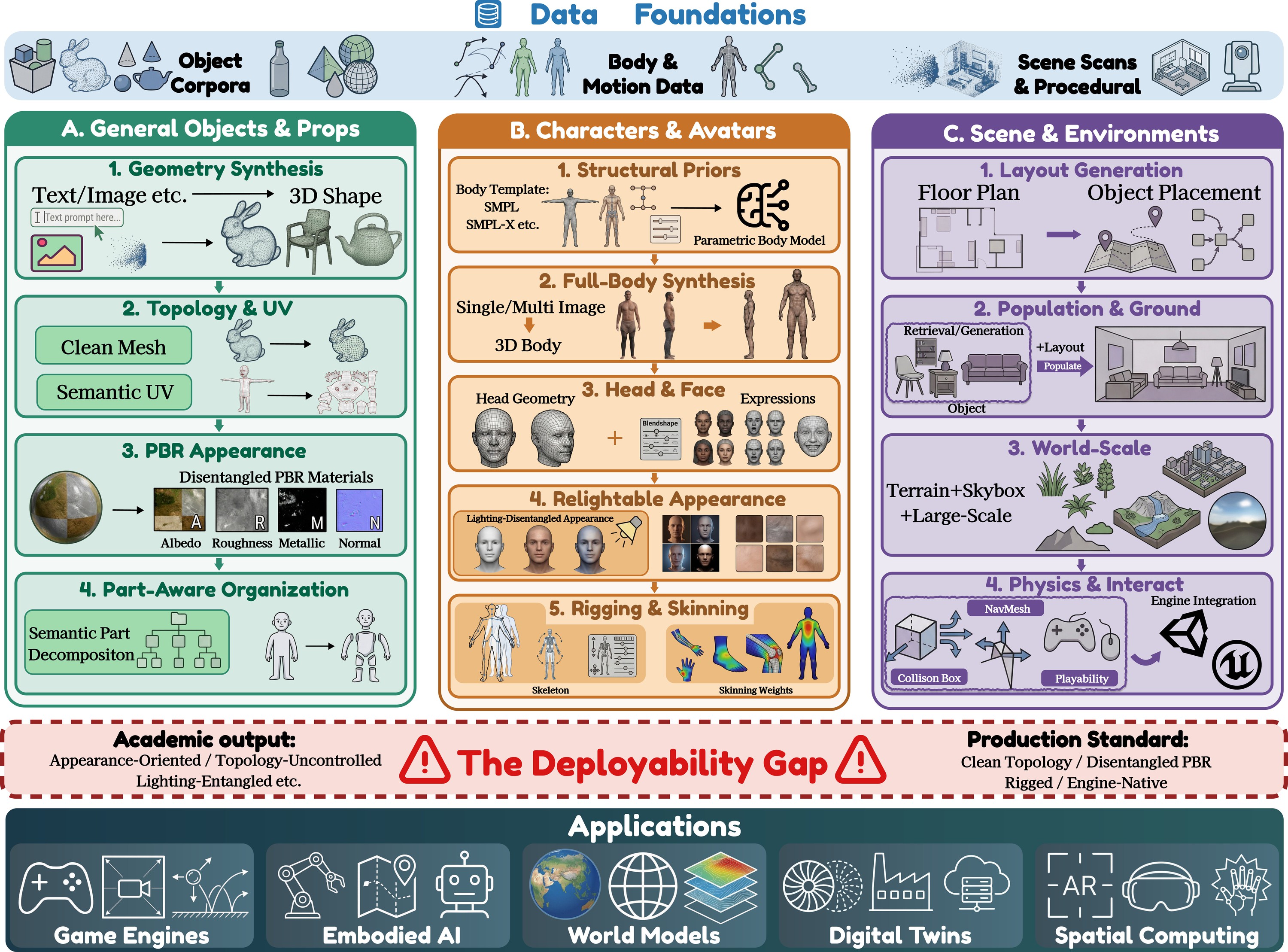
Pipeline taxonomy overview of the survey
Our taxonomy unites 3D synthesis research with deployable engine assets.

Overview

Three-dimensional content generation has progressed from producing isolated, visually plausible shapes to constructing structured assets that can be deployed in real-time interactive environments. This trajectory is driven by converging demands from game development, embodied AI, world simulation, digital twins, and spatial computing, all of which require 3D content that goes beyond surface appearance to satisfy engine-level constraints on topology, UV parameterization, physically based materials, skeletal rigging, and physics-aware scene layout. Despite rapid advances in generative modeling, a persistent gap separates the outputs of current methods from the production-ready standard expected by interactive applications. This survey addresses that gap by organizing the literature around the asset production pipeline rather than algorithmic families. Along the horizontal axis we distinguish three asset tiers—namely general objects, characters, and scenes—while the vertical axis traces each tier through the full production lifecycle from data foundations and geometry synthesis through topology optimization, UV unwrapping, PBR appearance, rigging, and scene assembly. Through this two-dimensional taxonomy we assess not only what current methods can generate but whether their outputs are directly usable in downstream engines and simulation platforms. We further consolidate evaluation metrics and protocols that span geometric fidelity, appearance quality, asset usability, and scene-level physical plausibility. The survey concludes by identifying open challenges in data quality, generation controllability, end-to-end assetization, and physically grounded generation, and by situating production-ready 3D content as foundational infrastructure for emerging interactive world models and embodied intelligent systems.
Production Pipeline Taxonomy

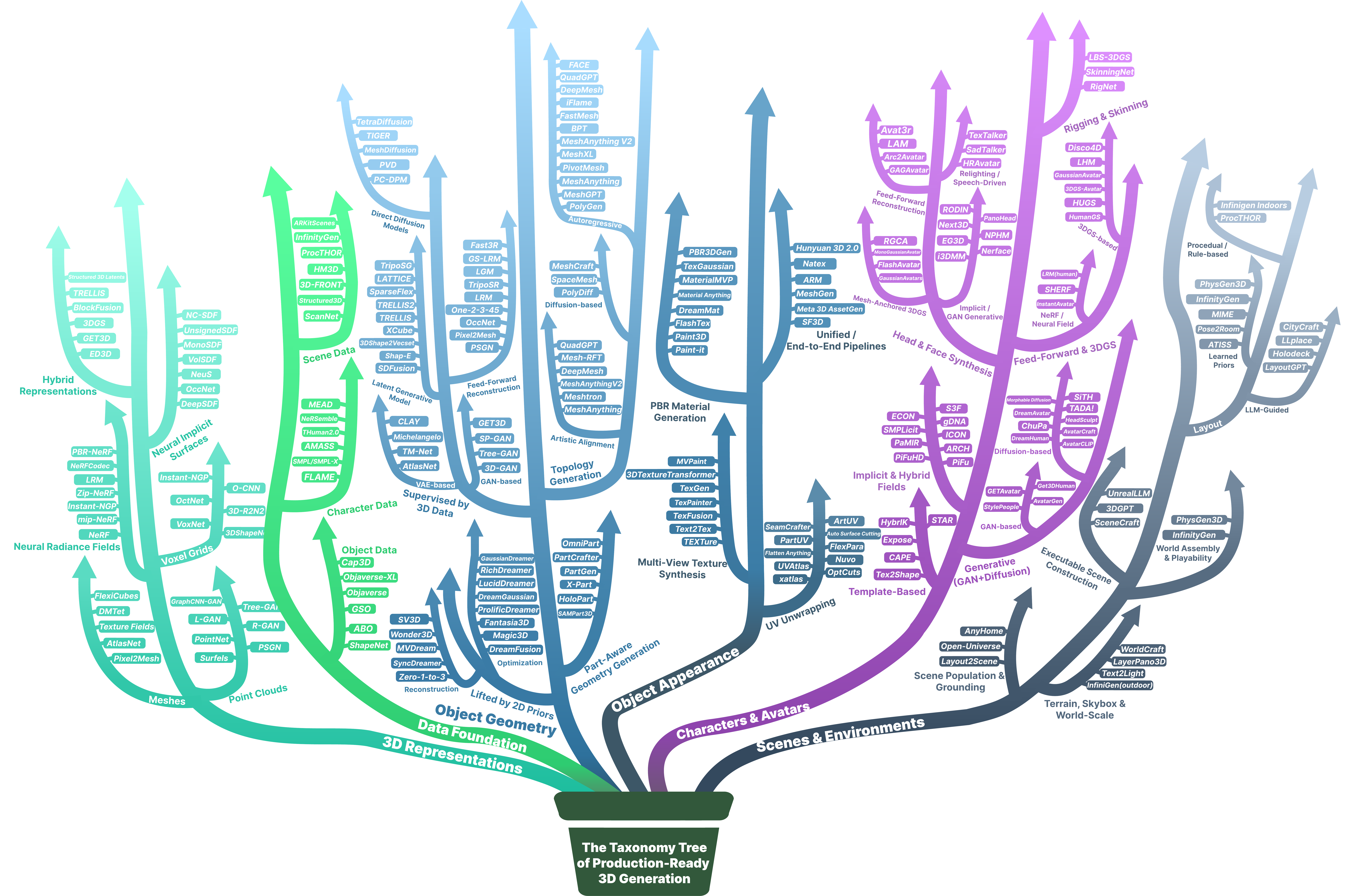
Survey taxonomy tree

Pipeline Stages

Data
Geometry
Topology
UV Unwrapping
Texture
Rigging
Scene Assembly

General Objects follow a geometry–topology–appearance pipeline. Methods reconstruct geometry from single-view or multi-view input, refine topology into manifold quad-dominant meshes, then generate UV maps and physically based texture for engine-ready assets.

Representative Methods

  • DreamFusion 2022 — Text to 3D generation via score distillation without 3D supervision
  • 3DShape2VecSet 2023 — Diffusion based shape generation with compact vector set representation
  • Fantasia3D 2023 — Text to 3D synthesis by disentangling geometry and appearance
  • MeshGPT 2024 — Mesh token generation with strong topology quality
  • TRELLIS.2 2025 — Scalable LGM with high geometry fidelity
  • QuadGPT 2025 — Autoregressive native quadrilateral mesh generation with topology control

Characters & Avatars follow a body–head–rigging pipeline. Methods generate articulated human bodies and expressive heads, align geometry with parametric priors, and assign skeletal structure with skinning weights to produce animation-ready assets with stable motion and facial control.

Representative Methods

  • TADA! 2024 — Text to avatar on SMPL X with LBS ready output
  • LHM 2025 — Single image to animatable avatar in real time
  • LAM 2025 — Real time head avatar at 280 FPS for mobile
  • GaussianAvatars 2024 — FLAME anchored 3DGS head avatar animation
  • HRAvatar 2025 — High resolution animatable avatar with relighting
  • TexTalker 2025 — Speech driven 3D talking head with texture control

Scenes & Environments follow a layout–grounding–world-scale pipeline. Methods first plan semantic layout, then ground assets with physically plausible placement, and finally scale to large environments with stable world composition.

Representative Methods

  • Holodeck 2024 — LLM driven embodied scene generation with interaction
  • SceneCraft 2024 — Text to 3D scenes through Blender scripting
  • Infinigen 2023 — Procedural photoreal natural world generation
  • LayerPano3D 2025 — Layered panoramic scene generation for immersive worlds
  • PhyScene 2024 — Physics guided diffusion for stable interactive scenes

Visual Results

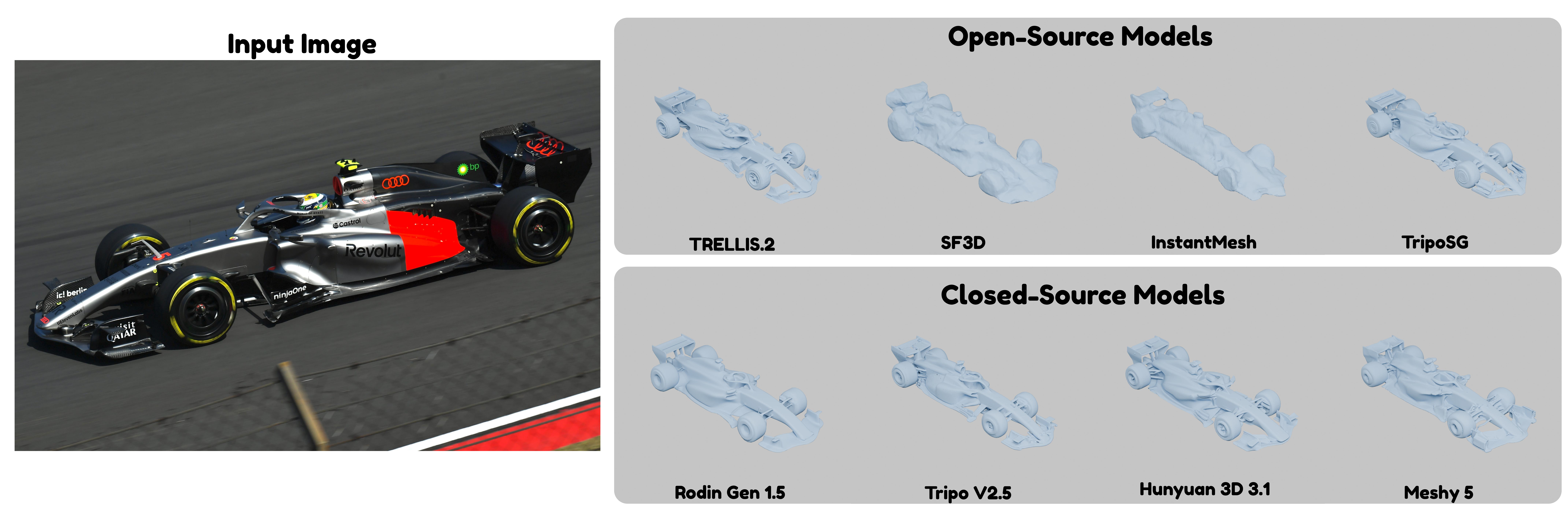
Open-Source vs Closed-Source 3D Generation Comparison
Unified Open and Commercial Benchmark We benchmark open-source and commercial 3D models under unified Blender rendering and input conditions: TRELLIS.2, SF3D, InstantMesh, TripoSG, Rodin Gen1.5, Tripo v2.5, Hunyuan3D 3.1, Meshy AI 5.
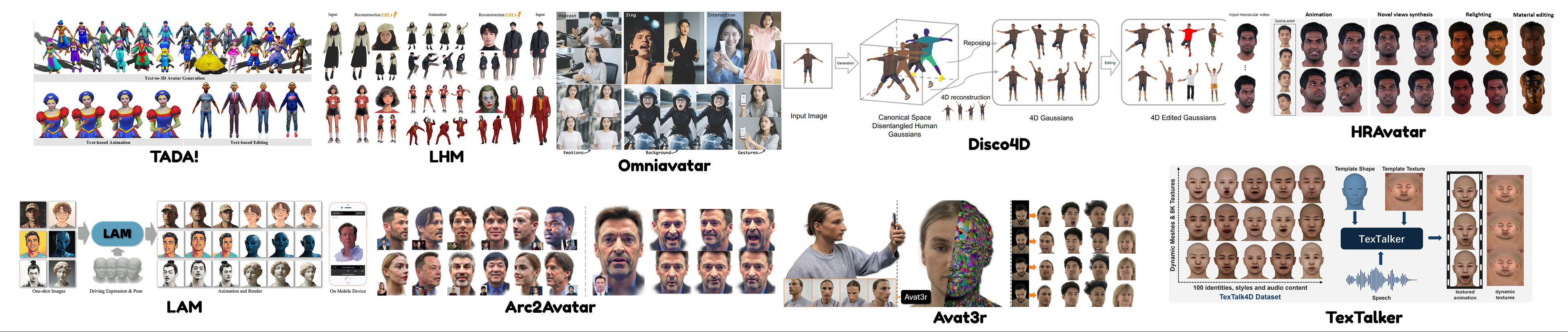
Character and Avatar Generation Methods (2024-2025)
Character and Avatar Landscape Recent methods cover text, feed-forward, speech-driven generation, with TADA!, LHM, OmniAvatar, Disco4D, HRAvatar, LAM, Arc2Avatar, Avat3r, TexTalker excelling in real-time performance.

Survey at a Glance

150+
Methods Surveyed
40+
Datasets Catalogued
6
Production Criteria

Production-Ready Criteria

Manifold Mesh Topology

Watertight non self intersecting meshes with clean manifold edges for Boolean editing physics simulation and direct engine import.

UV Parameterization

Clean UV atlases with low distortion and no overlap for accurate texture mapping and physically based material baking.

Disentangled PBR Materials

Independent albedo roughness metallic and normal maps for robust relighting in real time renderers.

Skeletal Rig & Skinning

Structured skeletons with LBS compatible skinning weights for mocap animation and procedural motion control.

Post-generation Editability

Assets remain editable in standard DCC tools such as Blender Maya and 3ds Max without full regeneration.

Physics Metadata

Collision meshes mass properties and material tags support rigid body and soft body simulation in game engines.

Method Overview

LGM= Large Generation Model FF= Feed Forward Topo= Topology Aware SDS= Score Distillation Gen= Generative FFrec= Feed Forward Reconstruction Lay= Layout Gnd= Grounding Wld= World Scale

MethodYearTypeKey FeatureLinks
DreamFusion2022 SDS Text to 3D generation via score distillation without 3D supervision
3DShape2VecSet2023 Gen Diffusion based shape generation with compact vector set representation
Fantasia3D2023 SDS Text to 3D synthesis by disentangling geometry and appearance
MeshGPT2024 Topo Mesh token generation with strong topology quality
TRELLIS.22025 LGM 4B model with high fidelity mesh and texture
QuadGPT2025 Topo Autoregressive native quadrilateral mesh generation with topology control
InstantMesh2024 FF Multi view diffusion to mesh with fast feed forward inference
LGM2024 LGM Large multi view Gaussian model with fast generation
PivotMesh2025 Topo Pivot guided mesh generation with topology control
Hunyuan3D 2.02025 LGM Large scale 3D asset generation with material synthesis
MethodYearTypeKey FeatureLinks
TADA!2024 Gen SMPL X avatar generation with LBS ready output
LHM2025 FF Single image animatable avatar with real time rendering
LAM2025 FFrec 280 FPS head avatar for mobile deployment
GaussianAvatars2024 GS FLAME anchored 3DGS head avatars in real time
HRAvatar2025 Gen High quality relightable Gaussian head avatar
TexTalker2025 Gen Speech driven 3D talking head with texture control
OmniAvatar2025 Gen Avatar generation with multimodal control
Disco4D2025 FF Monocular video to dynamic 4D avatar
Arc2Avatar2025 FFrec Archetype guided avatar generation from sparse views
MethodYearTypeKey FeatureLinks
Holodeck2024 Lay Embodied scene generation with interactive objects
SceneCraft2024 Gnd Text to 3D scene via Blender scripting
Infinigen2023 Wld Procedural photoreal natural world generation at large scale
LayerPano3D2025 Gnd Layered panoramic scene generation for immersive VR
PhyScene2024 Gnd Physics guided diffusion with stability checks
GameGen-X2024 Wld Open world game environment generation
GALA3D2024 Lay Layout guided 3D asset generation with compositional control

Interactive Demos

A rotating Hunyuan3D 3.0 GIF preview is available below, and additional representative method viewers are in preparation.

General Objects

TRELLIS.2
Coming Soon
TripoSG
Coming Soon
SF3D
Coming Soon
Rotating GIF preview of Hunyuan3D 3.0
Hunyuan3D 3.0
GIF Preview

Characters & Avatars

TADA!
Coming Soon
LHM
Coming Soon
GaussianAvatars
Coming Soon
LAM
Coming Soon

Scenes & Environments

Infinigen
Coming Soon
Holodeck
Coming Soon
SceneCraft
Coming Soon

BibTeX

If you find this survey useful in your research, please consider citing:

@misc{wu2026visualsynthesisinteractiveworlds,
  title         = {From Visual Synthesis to Interactive Worlds: Toward Production-Ready 3D Asset Generation},
  author        = {Jiafeng Wu and Zhuofan Lou and Jian Liu and Dazhao Du and Chunchao Guo and Song Guo},
  year          = {2026},
  eprint        = {2604.23629},
  archivePrefix = {arXiv},
  primaryClass  = {cs.GR},
  url           = {https://arxiv.org/abs/2604.23629}
}